A few stray thoughts about proof

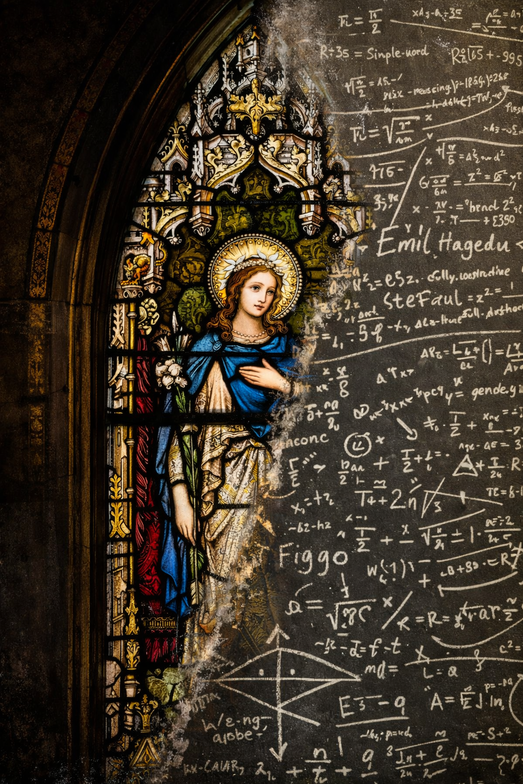
Friends! It has been a little while since I have written for our church blog. I had hoped for a blog a month, but I think I missed that mark. Ah well. I wonder who actually reads these?
As you know, I was on sick leave for a stretch and first I want to thank you for your prayers and support. It was a slog and I only recently started to feel like myself again. But I also started a new course in my online Masters in philosophy this year, which means I am probably more philosophical than usual. For those who know me, this may be mildly (terrifyingly?) concerning.
Well, recently I had one of those longer conversations that I just can’t forget. I've walked away replaying parts of it in my head, thinking, I wish I had said that more clearly. Or perhaps, I should have listened a little longer there. Definitely I should have.
If I am honest, I may have talked a bit too much. I am feeling appropriately sheepish about that. Y’all know how that goes.
And since we are in the season of Lent, it felt right to slow down and take a more honest look at my own reactions and assumptions. Maybe this is, in a small way, part of the work of repentance. Not dramatic repentance, something ordinary and thoughtful.
One theme from that conversation has stayed with me. The question of proof. What counts as proof. Whether proof for God is even possible. And perhaps whether we even need it.
So here we go, let’s get it.
I think we first need to clarify what we usually mean when we say there is no proof for God. In many conversations, the word proof is doing more work than we notice, and to remain honest we have to recognize what freight it's carrying. Often what is really meant is not strong evidence, but absolute, mathematical certainty.
And this is where we need to put our philosophy hats on because we have to untanlge this unfair knot.
Because if someone claims that only what can be proven with absolute certainty should be believed, that claim itself has to meet the same standard, otherwise the rule undercuts itself. I have yet to see a convincing argument that rational belief must be limited only to what can be known with geometric certainty.
In fact, most of what we responsibly believe in everyday life does not meet that bar.
Consider:
- In a courtroom, jurors are not asked to reach metaphysical certainty. They are asked to weigh evidence beyond a reasonable doubt.
- In medicine, physicians regularly act on the best available evidence without perfect diagnostic certainty.
- In ordinary life, we trust memory constantly without demanding scientific proof. If you asked me what I ate for breakfast and I said Cheerios, I probably could not prove it to you an hour later. The bowl has been washed and in the cupboard. The box is back in the pantry. But I would still be rational to trust my own memory unless I had a serious reason to doubt it, say, if I had strong evidence of memory loss or some kind of cognitive impairment.
And once we admit that memory and testimony count as real sources of knowledge in ordinary life, it becomes much harder to dismiss historical claims about Jesus simply because they are not scientifically repeatable.
In other words, rational belief normally works with degrees of confidence, not absolute demonstration.
Which raises what I think is the more honest question.
Not whether Christianity can be proven with the kind of certainty we expect in mathematics, but whether there are serious historical and philosophical reasons to think it is true.
There is another dynamic here that is worth naming.
In many areas of life, especially in science and medicine, we are quite comfortable living with probabilistic knowledge. We accept models, inferences, and best explanations. But when the conversation turns to God or ultimate reality, the epistemic bar sometimes rises very quickly. Suddenly only certainty will do.
Sometimes that may reflect intellectual humility. But sometimes, if we are honest, it may reflect something else.
As Charles Taylor has noted in various ways, the modern scientific posture can give us a sense of distance and control. We stand back. We analyze. We manage. But religious claims, if true, do not simply invite analysis. They invite response. I bet we sense that at some level, they invite submission.
And it is at least worth asking ourselves:
- Am I raising the standard of proof here out of careful reasoning?
- Or because the conclusion, if true, might actually ask something of me?
I’m not asking rhetorically. I ask it as someone who has had to ask it of himself more than once.
Because the heart of the Christian claim is not that we should believe things without evidence. It is that we should follow the truth wherever it leads, even when it is inconvenient.
And that, I suspect, is where the conversation about proof becomes most interesting.
-
St George in the Pines Anglican Church
Contact
